
The Hidden Tech That Safely Lifts an Electric Car
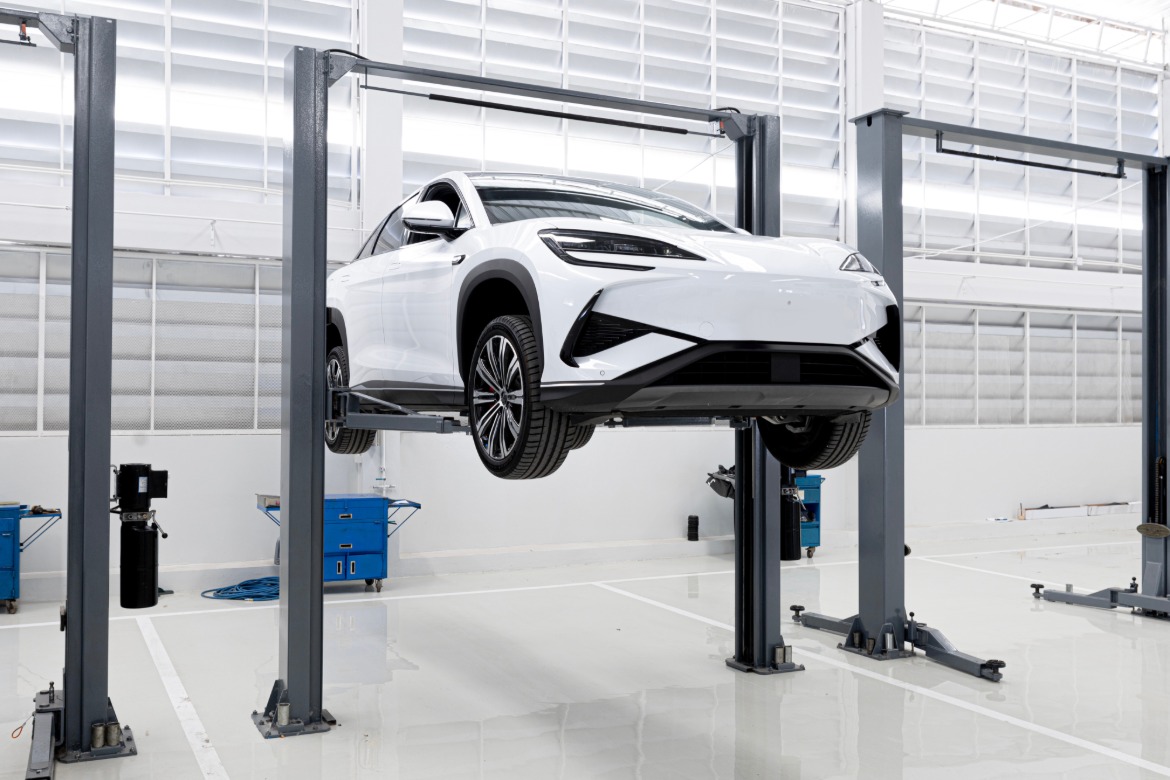
An electric car rolls into a repair bay with a complaint that sounds routine: a mystery rattle or brakes that have seen better days. Then comes the deceptively simple part. The car has to leave the ground.
That moment reveals the hidden tech that safely lifts an electric car—a layer of automotive engineering most drivers never see. Lifting an EV is not a matter of finding four convenient spots and pressing an up button. The vehicle may carry much of its mass in a wide battery pack beneath the cabin, exactly where careless contact could cause expensive damage. Technicians rely on vehicle data and carefully positioned hardware to raise it safely.
So, how do repair shops lift electric cars without turning a service appointment into the world’s least entertaining science experiment? The answer starts with weight, but it does not end there.
EVs Rewrite the Weight Map
Gas-powered vehicles usually concentrate major components around the engine bay and drivetrain. An EV rearranges that familiar layout. Its large traction battery often stretches across much of the floor, creating a low center of gravity and distributing mass differently from the vehicles many lifts were originally chosen to handle.
Extra capacity alone does not solve the puzzle. A lift can have an impressive rating and still be a poor match if its arms cannot reach the correct contact points. The car’s balance can rule out an otherwise capable setup, too. Shops also have to match the lift to the vehicles it needs to handle, not just compare the largest number on a specification sheet. Those fit questions matter even more as heavier battery-powered models become common.
Think of it like choosing a stand for an enormous gaming monitor. The number on the box matters, but so do the mounting pattern and the base. Scale that idea up to several thousand pounds, and the margin for improvisation disappears.
The Battery Pack Claims the Floor
Underbody access used to offer technicians a generous landscape of structural metal. On many EVs, the battery enclosure now occupies prime real estate. It is sturdy by necessity, but that does not make it a lifting surface. A misplaced arm or adapter can press on a battery shield or coolant path. It might also touch a component that was never designed to carry the vehicle.
Because the electrical architecture inside an EV connects its battery pack to systems throughout the car, technicians must treat the underbody as more than an open stretch of metal. The vehicle manufacturer defines the safe contact points, and they may be small or recessed. Worse, they can look a lot like nearby areas that must be avoided.
This is where information becomes part of the lifting equipment. Before the vehicle rises, a technician confirms the exact model and checks the manufacturer’s guidance. Then the technician picks the contact method meant for that design. Those details can change across model years and battery configurations, even when two cars look almost identical from the parking lot.
The Lift Coordinates the Climb
A modern vehicle lift can look wonderfully simple, with tall posts beside the car and movable arms underneath it. Behind that clean silhouette is a coordinated system built to move a large load while keeping it level and mechanically supported.
Depending on the lift type, an electric motor may drive hydraulic or mechanical components. Synchronized mobile columns can share the work on larger vehicles. Mechanical locks provide support at working height, while arm restraints help keep positioned arms from wandering. Some systems also monitor movement between sides or columns so the vehicle rises evenly. None of these features replaces correct setup; each adds another layer of protection.
The rated capacity applies to the complete lifting system under its specified conditions. It is not permission to treat every arm or adapter as if it can carry the full number printed on the lift. Weight distribution still matters. That is why the vehicle’s center of gravity and the lift maker’s instructions remain part of the decision.
Four Contact Points Carry the Load
The most dramatic machinery in the bay may be the tall steel lift, but the real handshake happens at the contact points. Adapters or pads bridge the gap between the lift arms and the vehicle’s reinforced areas. Their shape and height help create stable contact without crushing trim, slipping off an edge, or touching the battery enclosure.
Once the pads are positioned, technicians do not simply send the car to the ceiling. A cautious initial raise allows them to confirm that every contact remains seated and that the vehicle is stable before continuing. At working height, the lift rests on its mechanical locking system rather than relying only on lifting pressure.
That sequence may not look futuristic, but it is a smart example of safety engineering. First, verify the data and establish the right interface. Then test the load before relying on a physical fail-safe. Software fans might recognize the philosophy: never trust one layer when several independent checks can do the job better.
Repair Bays Become EV Tech Zones
The lift is only one piece of an EV-ready bay. Technicians may also need high-voltage training and insulated tools. Battery work calls for dedicated handling equipment and enough clear floor space to manage large, awkward components. If a battery pack must be removed, a separate lifting table supports and lowers it in a controlled way; the vehicle lift itself is not a giant battery jack.
Shop planning is changing, too. Managers have to think about ceiling height and floor strength before new equipment arrives. They also plan around power needs and the mix of vehicles they expect to service. Even the reach of the lift arms can determine which bay works. A compact commuter EV and a long-wheelbase electric van can place very different demands on the same space. A battery-powered pickup raises the stakes again.
For drivers, most of this work remains invisible. That is the point. The best lift technology turns a risky physical task into a calm, repeatable process. The car goes up, and the technician gains access. Nobody needs a viral video of what happened next.
The Procedure Ties the System Together
Electric cars are packed with processors and sensors, but lifting one safely depends on something more basic: matching the machine to the vehicle and following the right method. Capacity must suit the actual load. Arms and adapters must reach the manufacturer-designated points. Locks and restraints must do their jobs. Trained technicians must verify the setup instead of guessing from a familiar silhouette.
Together, that machinery and method form the hidden technology that gets an electric car safely off the floor. Drivers will rarely see it in action, and that is fine. When an EV rises smoothly above a repair bay, a surprisingly sophisticated system is keeping a very heavy gadget—and the people working beneath it—securely in place.