
How To Design a Slot Car Track That Stays Fun
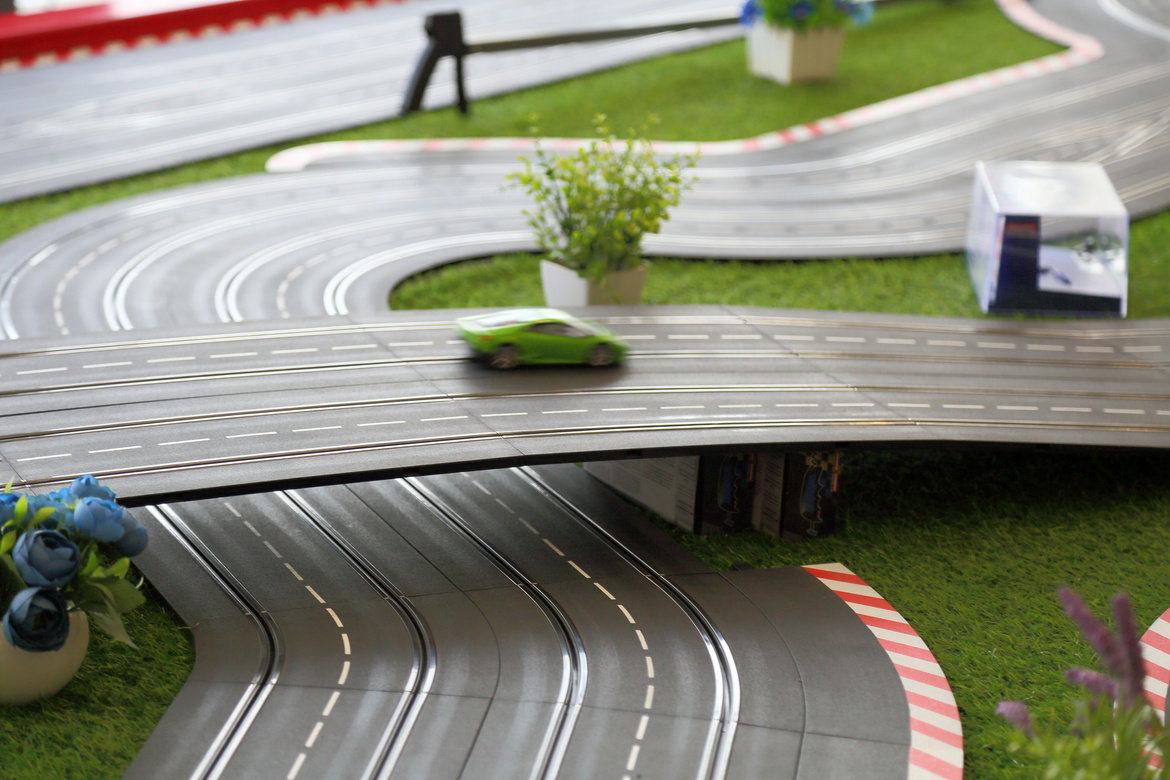
There’s something deeply satisfying about watching a tiny car absolutely fly around a slot car track. Then comes the inevitable urge to make the layout bigger, faster, twistier, and generally more ridiculous. Before long, you’ve created a miniature IndyCar road course that takes up half the room and sends cars airborne every third lap.
Part of the appeal is figuring out how all those pieces should work together. Designing and racing a slot car track is, at its core, a problem-solving hobby that encourages strategic thinking. Every curve, straightaway, elevation change, and braking zone affects how the circuit feels once the cars start moving.
More track, however, doesn’t automatically mean more fun. The best layouts balance speed, technical driving, competition, and variety and give beginners a fighting chance while leaving enough room for experienced racers to chase faster laps. Learning how to design a slot car track that stays fun means thinking less like someone assembling every track piece in the box and more like a game designer building something that people will want to play repeatedly.
Start With the Space, Not the Track Pieces
Before designing the ultimate racing empire, figure out exactly how much room you have. Squeezing track into every available inch can be tempting, but an enormous layout can become annoying if you can’t reach a crashed car in the back corner. Leave enough space around the track to retrieve cars, clean the rails, adjust the scenery, and troubleshoot connections.
Also consider sight lines. Drivers should be able to see the entire circuit from their racing positions. A spectacular elevated section becomes considerably less spectacular when it blocks everyone’s view of the hairpin underneath it.
Measure your available area and sketch a rough footprint first. That gives you boundaries to work within—and boundaries can actually make the design process more creative.
Build Around a Few Memorable Features
A fun circuit needs personality. Instead of creating an endless sequence of similar corners, give the track a handful of recognizable sections. You might include:
- A long straight where cars can stretch their legs (so to speak)
- A tight technical section requiring careful throttle control
- A sweeping corner that rewards carrying speed
- An elevated section or bridge that changes the visual rhythm
- A tricky braking zone before a sharp turn
Think of these as your track’s landmarks. Racers will quickly start to develop strategies around them, and that process of figuring out a course is part of the appeal. Racers aren’t simply holding down a controller trigger; they’re constantly learning where to accelerate, brake, and take calculated risks.
Don’t Make Every Corner a “Gotcha”
Loops, jumps, bridges, banked turns, lane changers, tunnels—slot car accessories can awaken the same part of the brain that insists a gaming PC needs just one more RGB component.
However, while a difficult corner can be fun, twelve difficult corners in a row can feel like punishment. Technical sections work best when contrasted with faster, more forgiving parts of the track. After navigating several tight turns, racers should get a chance to open the throttle and enjoy some speed.
Pay particular attention to corners that follow long straights. A sharp turn after a full-throttle section creates an obvious braking challenge, which can be exciting. But if every straight ends with a car-launching trap, drivers will spend more time putting cars back into their slots than actually racing.
Create More Than One Kind of Challenge
If the only goal is “go as fast as possible,” a track may become predictable once everyone learns it. Instead, create a circuit that tests several skills. One area might reward smooth throttle control, while another might favor precise braking. A long straight can emphasize outright speed, and a sequence of curves can reward consistency.
This variety also makes different cars more interesting to drive. One model may dominate the straight but feel nervous through technical sections. Another might lack top speed yet glide through corners. Choosing a car will suddenly involve more than picking whichever one looks coolest—although picking the coolest-looking car remains a perfectly respectable Geek strategy.
Leave Room for Improvement
One of the easiest ways to kill replay value is to make a track either impossibly difficult or trivially easy. A good layout gives new racers achievable goals. First, they learn to complete a clean lap. Then, they try to finish several laps without leaving the slot. Eventually, tenths of a second begin to matter.
That progression gives players reasons to keep racing. Once drivers become comfortable with a layout, they can start setting realistic lap-time goals and experimenting with braking points, acceleration, and consistency rather than simply trying to survive the circuit.
You can even keep a small leaderboard near the track. Record personal bests, fastest clean laps, or records for different cars. A little friendly competition can turn an ordinary evening of racing into a serious championship.
Give Passing Some Thought
When multiple people race together, overtaking opportunities matter. A circuit that heavily favors one lane or that provides few practical opportunities to challenge another driver can get frustrating. Depending on your track system, experiment with lane changes, straight lengths, corner placement, and other features that encourage racers to interact.
Competition becomes much more interesting when drivers have decisions to make. Should you push harder now? Wait for a better opportunity? Protect a lead rather than chase a record lap? Those little decisions transform the track from a moving toy display into a genuine game.
Make the Track Easy To Change
You don’t necessarily need one perfect layout forever. In fact, designing for change can dramatically extend your setup’s lifespan.
Keep a few sections modular so that you can swap a sweeping corner for a technical sequence, extend a straight, reverse the racing direction, or create shorter configurations. Even modest changes force racers to rethink familiar strategies.
If you build permanent scenery, avoid locking every piece of track into a configuration that can never evolve. Modular scenery and accessible connections make experimentation much easier.
Test With Different Racers
The designer is often the worst person to judge whether a track is balanced.
You already know every corner. You know where to brake, which sections are deceptive, and exactly how hard you can push before a car launches itself toward the nearest piece of furniture.
Hand the controllers to other people. Watch where beginners struggle, where experienced racers get bored, and which sections consistently produce exciting battles. You may discover that a corner you considered brilliantly technical is actually just annoying.
Build a Track You’ll Want To Race Again
The secret to designing a slot car track that stays fun isn’t maximum complexity—it’s replayability.
A great circuit has a rhythm: bursts of speed, technical challenges, moments of tension, and enough breathing room to let racers settle into a groove. Beginners can enjoy it without constantly crashing, while experienced drivers can spend hours shaving fractions of a second from their best times.
So don’t judge your track by how many pieces it uses or how impressive it looks in a photo. Judge it by a much more important metric: When the race ends, does everyone immediately want another one? If the answer is yes, you’ve built the right track.